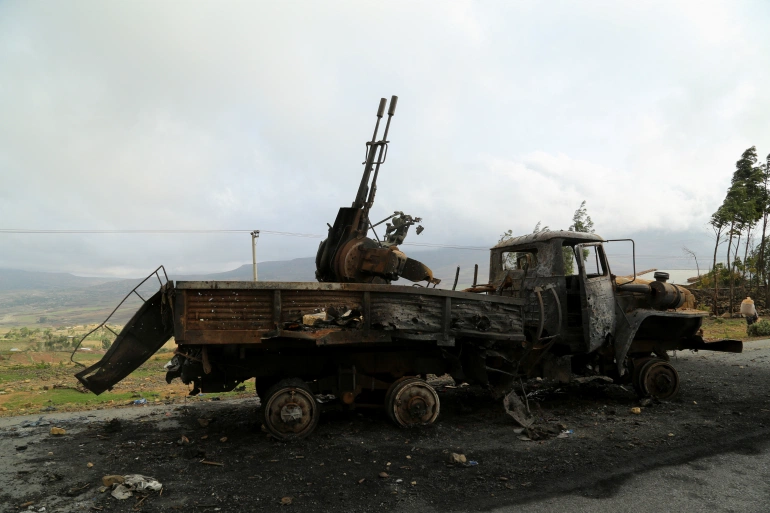
Aljazeera: USAID chief Power says Tigray rebels should exit border regions

The head of the US Agency for International Development (USAID) said she had raised concerns about “dehumanising rhetoric” with Ethiopian authorities and also called on rebel forces to “immediately” withdraw from two regions bordering the country’s war-hit Tigray.

Wednesday’s call by Samantha Power came as the conflict threatens to envelop other parts of the country and humanitarian groups struggle to reach cut-off populations.

NRC: Statement on the suspension of programmes in Ethiopia

The Norwegian Refugee Council (NRC) has suspended its humanitarian programmes in Ethiopia following a directive from the Government of Ethiopia.

On 30 July, the Ethiopian authorities ordered the Norwegian Refugee Council (NRC) to suspend all operations in the country for three months, citing concerns about some of NRC’s public messaging and compliance with certain rules and regulations.

“We have enjoyed respectful and collaborative relations with all branches of the Ethiopian Federal Government since we started working in Ethiopia in 2011,” said Ole Solvang, partnerships and policy director at NRC. “We are in dialogue with the relevant authorities to clarify and follow up on any concrete concerns they may have so that we can resume our much-needed humanitarian work.”

NRC has provided education, clean water and sanitation facilities, shelter, food and legal identify in Ethiopia since 2011. In 2020, NRC assisted 585,000 people in six regions of Tigray, Oromia, SNNP, Benishangual Gumuz, Gambella and Somali region, and in Addis Ababa city.

PBS: Ethiopian government appears determined to target Tigray as humanitarian crisis deepens (Transcript)

The Biden administration this week sent its most senior official yet to Addis Ababa, the capital of Ethiopia. USAID Director Samantha Power is putting pressure on the Ethiopian government and its Nobel Peace Prize-winning prime minister to alleviate a humanitarian crisis in the country’s Tigray region. But as Nick Schifrin reports, the Ethiopian government seems determined to target Tigray

nytimes: As Ethiopia’s Civil War Rages, Bodies Float Downriver Into Sudan

The bodies floated over the border in ones and twos, bloated and bearing knife or gunshot wounds, carried on waters that flow from the Tigray region of northern Ethiopia.

At least 40 bodies have washed up on a riverbank in eastern Sudan in the past week, in some cases just a few hundred yards from the border with Ethiopia, according to international aid workers and doctors who helped retrieve the corpses.

The grisly finds at the river are apparent evidence of the latest atrocities in a brutal, nine-month civil war between Ethiopian federal forces and their allies, and fighters in the Tigray region of northern Ethiopia — a conflict accompanied by reports of massacres, ethnic cleansing and widespread sexual assault.

DW: Ethiopia – A catastrophe in the making

Thousands of people have died, around 2 million have been displaced, more than 5 million rely on emergency food aid and 400,000 are at risk of starvation. But violence in Ethiopia is growing beyond Tigray province.

In Ethiopia’s Tigray province, a lack of medical supplies, frequent power cuts and a severe fuel scarcity — not to mention a cash shortage due to closed banks, and growing unemployment after factories were shut down or looted — is making life increasingly difficult for the population, according to the International Committee of the Red Cross (ICRC).

“The humanitarian situation is very worrying and getting worse,” said Alyona Synenko, the ICRC’s spokesperson for Africa.

AFP: UN condemns ‘dangerous’ claims of bias against aid workers in Tigray

The UN’s humanitarian chief on Tuesday condemned as “dangerous” accusations by Ethiopian government officials that aid workers were biased in favour of — and even arming — rebel forces in war-hit Tigray.

Martin Griffiths also called for access to allow desperately needed aid into the region where the UN says hundreds of thousands of people are suffering from famine.

“Blanket accusations of humanitarian aid workers need to stop,” he said during a press conference at the end of a six-day visit to Ethiopia, his first mission in his new role.

Bloomberg: Ethiopia Suspends Two Humanitarian Groups From War-Torn Tigray

Ethiopia suspended the activities of two humanitarian organizations working in the war-torn Tigray region as the conflict in the north of the country enters its ninth month.

Medecins Sans Frontieres, one of only a handful of experienced international groups providing frontline health care to people in conflict areas, said it was told to cease their operations by the government late last month. The Norwegian Refugee Council, which provides assistance to nearly 600,000 people in six regions across Ethiopia, was given similar orders.

BBC: Ethiopia – Growing concerns for unity as Tigray conflict spreads

There are increasing concerns about Ethiopian unity as the conflict in the northern Tigray region escalates.

The nine-month-long war between Tigrayan rebel forces and the Ethiopian army and its allies has been mostly contained in Tigray itself.

But the fighting is spreading into the neighbouring regions of Amhara and Afar.

This is off the back of Tigrayan forces making significant territorial gains, including capturing the regional capital, Mekelle, in June after Ethiopian troops withdrew and the government declared a unilateral ceasefire.

Ethiopia’s Problems Stem From Internal Colonialism

The reality is that the Ethiopian state is unraveling, with the TPLF defeating Ethiopian and Eritrean forces in Tigray and the Oromo Liberation Army making significant inroads on the battlefield in Oromia, the largest state in the country. Indeed, as I have written elsewhere, Ethiopia will perish ingloriously if it fails to accommodate the legitimate demands of the federalist camp.

Tigray: As famine looms, first WFP humanitarian flight arrives

As conflict escalates in the surrounding regions, including neighbouring Afar, safe passage for humanitarian convoys into Tigray remains a primary concern for WFP and the humanitarian community. 

WFP hopes to reach an additional 80,000 people in the northwest, warning that once distributed, food stocks are likely to run out thereafter.