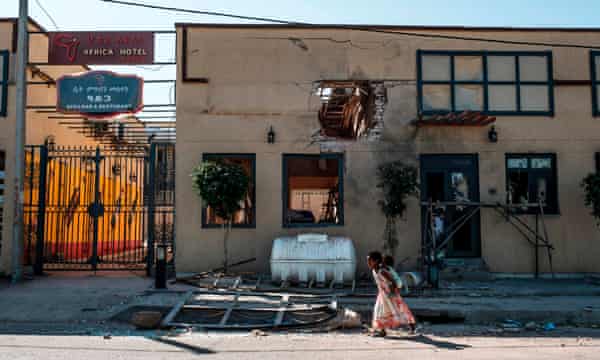
Eritreans are being rounded up and returned to war-torn Tigray or are being deported to their homeland.
Refugees said some people in the camps were being forcibly returned to Eritrea.
UNHCR’s emergency response team in Ethiopia, told VOA via email that his organization has not yet been granted access to return to the four refugee camps in Tigray
State Department spokesperson: Credible reports of Eritrean military involvement in Tigray and view this as a grave development.
Despite denials by Ethiopia, multiple reports confirm killings, looting and forcible return of refugees by Asmara’s forces
Residents had been “slaughtered like chicken”, the elders said, their corpses abandoned to be “eaten by hyenas”. They also spoke of rampant looting and vandalism: “All government assets have been destroyed and looted,” said one.
A spokesperson for the US state department later confirmed the details, marking a shift among US officials, who have previously praised Eritrea for its “restraint”. “We are aware of credible reports of Eritrean military involvement in Tigray and view this as a grave development,” said the spokesperson. “We urge that any such troops be withdrawn immediately.”
Mesfin Hagos, a former Eritrean defence minister turned opposition figure, said in an article for online publication African Arguments, that Isaias had deployed four mechanised divisions, seven infantry divisions and a commando brigade, citing sources in the defence ministry among others.
“This is a grave development,” said a US State Department Spokesman, describing what it said were “credible reports” of Eritrean troops fighting alongside the Ethiopian army in the northern Tigray state against the Tigray People’s Liberation Front (TPLF).
“We urge that any such troops be withdrawn immediately,” the spokesperson continued.
The TPLF accused the Ethiopian government of allowing the Eritreans to enter the conflict on ”several fronts”. Debtresion Gebremichael, ousted head of the Tigray state and TPLF chief also said his forces had captured Eritrean soldiers near Wikro, a town roughly 50km north of the Tigray capital Mekelle, though no evidence was shown.
Ethiopia: food rations for displaced people in Tigray have run out. We reiterate our urgent call for unconditional & safe humanitarian access to the affected regions. People in need are still not able to access any assistance. https://t.co/h8nSo9SHW4pic.twitter.com/ZqPNAlwux9
Many Eritreans, including those that oppose President Isaias Afwerki’s rule, are in a dilemma regarding the conflict in Tigray. Most Eritreans agree that he is the mastermind of it and stand against any involvement by their country. There are also a die-hard few that believe he is doing this in the interests of Eritrea.
At the start of the conflict, most Eritreans appeared opposed to any involvement in the conflict between TPLF and the Ethiopian federal government. Many of them had openly expressed their stand against the war and petitioned world leaders to intervene.
“Humera, only a few kilometres from the border to western Eritrea was heavily shelled by artillery in Eritrea forcing residents to fleeing into Sudan and facilitating control of western Tigray by Amhara militia, the regional force, and the federal army.”
Tigray leader Debretsion Gebremichael had vowed that Tigrayans would fight ‘the enemy’ anywhere and by all means, suggesting a tactical shift towards an insurgency-type engagement.
FILE – In this Saturday, July 14, 2018 file photo, Eritrean President Isaias Afwerki, center left, is welcomed by Ethiopia’s Prime Minister Abiy Ahmed, center right, upon his arrival at Addis Ababa International Airport, Ethiopia. Once official rivals, the leaders of Ethiopia and Eritrea have embraced warmly to the roar of a crowd of thousands at a concert celebrating the end of a long state of war. The 2019 Nobel Peace Prize was given to Ethiopian Prime Minister Abiy Ahmed on Friday Oct. 11, 2019. (AP Photo Mulugeta Ayene, File)/LON108/19284299557937/SATURDAY, JULY 14, 2018 FILE PHOTO/1910111107
The U.S. called for the immediate withdrawal of Eritrean troops from neighboring Ethiopia’s Tigray region, following “credible” reports of their involvement in a civil conflict.
The U.S. said it’s also aware of reports of human rights violations in the region, and called for an independent investigation of the matter.
The news came as the United States said it believes Eritrean troops are active in Ethiopia, a “grave development.” A State Department spokesperson in an email cited credible reports and said “we urge that any such troops be withdrawn immediately.”
The International Organization for Migration said it was “extremely concerned” about the refugees’ “forced” return and denied it was involved, saying Ethiopia took over one of its transit centers in the capital, Addis Ababa, on Dec. 3.
UNHCR said “overwhelming” number of reports about Eritrean refugees in Tigray being killed, abducted or forcibly returned to Eritrea.
“It is vital that Eritrean refugees be able to move to safe locations, and receive protection and assistance wherever possible, including outside of Tigray, given the traumatic events they report to have witnessed or survived,” UNHCR head Filippo Grandi.
Eritreans often leave to escape mandatory, indefinite military service and repression or search for better opportunities out of what has long been one of the world’s most isolated countries.
We are aware of credible reports of Eritrean military involvement in Tigray and view this as a grave development. We urge that any such troops be withdrawn immediately,” the spokesperson said.
The United States believes reports of Eritrean military involvement in the conflict in Ethiopia’s Tigray region are “credible,” a State Department spokesperson told Reuters on Thursday, despite denials by both nations.
U.S. officials believe reports of Eritrean military forces in the Tigray region of Ethiopia to be “credible,” a State Department spokesperson told Reuters.
The United States believes reports of Eritrean military involvement in the conflict in Ethiopia’s Tigray region are “credible,” a State Department spokesperson told Reuters on Thursday, despite denials by both nations.
“We are aware of credible reports of Eritrean military involvement in Tigray and view this as a grave development. We urge that any such troops be withdrawn immediately,” the spokesperson said.
“90% of the forces operating in Tigray are from Eritrea.”
The conflict, which began in early November, threatens to undo years of progress in Africa’s second most populous country and the restive Horn of Africa region. More than 47,000 Ethiopian refugees have now crossed into Sudan, said Babar Baloch, the global spokesman for UNHCR, the UN’s refugee agency.